Purify
TodayBiblePrayersSaints
Discover
CalendarCommunityShop
SupportAccount

The Bible

  • Old Testament
  • New Testament
  • Search

The Saints

  • The Saints
  • The Fathers
  • Writings

The Library

  • Reading
  • Discover
  • Councils
  • Topics
  • Heresies
  • Shop

The Calendar

  • Today
  • This month
  • Pascha
  • The fasts

The Prayer

  • Open today's prayer
  • Morning Rule
  • Evening Rule
  • The Jesus Prayer
  • Learn to Pray

About this work

  • About
  • Purify Plus
  • Privacy
  • Terms
  • FAQ
  • Support the work
  • What's new
  • Account

Find us

Discord@purifymylife@purify.app@purifymylife
Language
Purify

Glory to God for all things.

© 2026 · 1.7.2 · Public-domain texts unless otherwise noted.

St. Constantine the Great

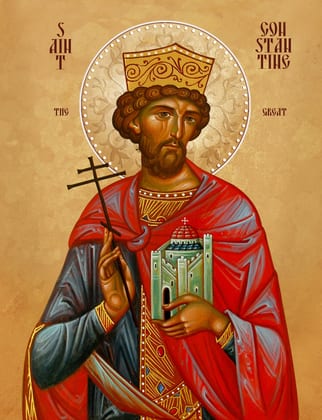
Icon of St. Constantine the Great

St. Constantine the Great

Equal-to-the-Apostles·Feast May 21

Ask for more writings

2 readers asked

The Emperor who saw the sign of the Cross in the sky before the battle of the Milvian Bridge, gave the Church her freedom by the Edict of Milan (313), summoned the First Ecumenical Council at Nicaea, and re-founded New Rome at Constantinople. Venerated together with his mother St. Helena, equal-to-the-apostles, who found the True Cross.

Born
c. 272 (Naissus, Moesia Superior)
Reposed
May 22, 337 (near Nicomedia)
See
Roman Emperor; baptized on his deathbed
Feast
May 21

Constantine was born around the year 272 in Naissus (modern Niš in Serbia), the son of the western Caesar Constantius Chlorus and the holy Helena, an innkeeper's daughter who had quietly been a Christian for most of her life. He grew up as a hostage at the court of Diocletian in the East, where he saw the great persecution of 303 with his own eyes: bishops imprisoned, churches burned, Scriptures put to the fire.

On the eve of the battle of the Milvian Bridge in October of 312, as he marched against his rival Maxentius for the rule of the Western half of the empire, Constantine saw a sign of the Cross in the sky at midday, together with the words ἐν τούτῳ νίκα, in this sign conquer. He placed the chi-rho on the shields of his army; he won the battle; and within months he had issued, together with his eastern colleague Licinius, the Edict of Milan, which gave the Church her freedom throughout the Roman world.

When he came to the sole rule of the empire in 324, he summoned the First Ecumenical Council to settle the Arian controversy. He paid the travel of the three hundred and eighteen Fathers from the public treasury; he opened the council in person with an oration in Latin; he assured the Fathers that whatever they decided would be the law of his empire; and at the close he kissed the scars of those who had been confessors in the recent persecutions before he kissed their bishop's rings.

1 work

  • The Vision and the Council
    The Vision and the CouncilFrom the Life of Constantine by Eusebius of Caesarea · c. 339Three scenes from Eusebius's contemporary biography: the vision of the Cross before the Milvian Bridge, the opening of the Council of Nicaea, and the death on the Day of Pentecost. With the standard apolytikia for the May 21 feast of Constantine and Helena.

Books in print

These works are licensed and copyrighted by their publishers and cannot be hosted on Purify. As an Amazon Associate, Purify earns from qualifying purchases.

  • Life of Constantine
    Life of ConstantineAbout Eusebius of Caesarea · Oxford University Press, 1999Eusebius' near-contemporary account of the emperor who gave the Church peace and summoned the First Council, the vision of the Cross, the founding of the City, and the letters preserved entire.Buy on Amazon
At a glance

Born
c. 272 (Naissus, Moesia Superior)
Reposed
May 22, 337 (near Nicomedia)
See
Roman Emperor; baptized on his deathbed
Feast
May 21

Holy St. Constantine the Great, pray to God for us.

He re-founded the old Greek town of Byzantium as a new Christian capital, Constantinople, the New Rome. He sent his mother St. Helena to the Holy Land, where she found the True Cross and built the great churches of the Anastasis at the Holy Sepulchre and of the Nativity at Bethlehem. He passed laws on the side of the Faith: the Lord's Day made a public rest, the cross adopted as the imperial standard, the crucifixion abolished as a punishment.

He delayed his own baptism, in the manner of many fourth-century Christians, until he was on his deathbed in 337. He was baptized at Nicomedia by Eusebius, the same bishop who had been the chief political patron of the Arian party at Nicaea, an irony the historians have not always known what to do with. He died on the Day of Pentecost, May 22, 337, in white baptismal garments. The Church glorified him equal-to-the-apostles, and keeps his memory with his mother St. Helena on May 21.

Events during this saint's life

  • 313The Edict of Milan
  • Summer 325The First Ecumenical Council at Nicaea
  • May 11, 330The Dedication of Constantinople
Explore the interactive timeline