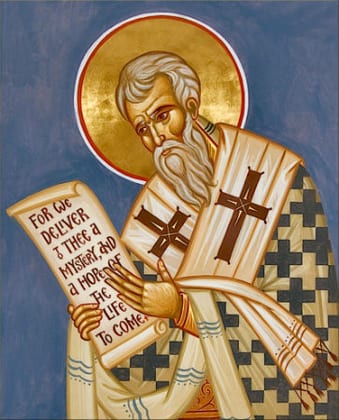
Patriarch of Jerusalem for thirty-five years, three times exiled by the Arianizing emperors for confessing the consubstantial Faith. His twenty-three Catechetical Lectures, preached to the catechumens in the Anastasis at the Holy Sepulchre in the years before his consecration, are the foundational fourth-century introduction to the Christian Mysteries.
- Born
- c. 315 (Jerusalem)
- Reposed
- March 18, 386 (Jerusalem)
- See
- Jerusalem
- Feast
- March 18
Cyril was born around the year 315 in or near Jerusalem, in the years just after Constantine's restoration of the Holy City and the building of the great church of the Anastasis at the Holy Sepulchre. He was raised in the Faith, ordained presbyter under his predecessor Maximus around 343, and during his presbytery preached the twenty-three Catechetical Lectures that have come down to us: eighteen pre-baptismal lectures to the catechumens during Great Lent (the Procatechesis and Catecheses I-XVIII), and five mystagogical lectures to the newly-baptized during Bright Week (the Mystagogical Catecheses).
He was consecrated Patriarch of Jerusalem around the year 350, in succession to Maximus. His relations with the Arianizing metropolitan of Caesarea (Acacius) were difficult from the start: Cyril held the Nicene Faith without ambiguity, and the more Acacius pressed his Arianizing sympathies, the more clearly Cyril preached against them. Acacius secured his first deposition in 357 on a pretext about church property he had sold to feed the poor during a famine. Cyril was sent into exile in Tarsus.
He was restored by the Council of Seleucia in 359, exiled again under Constantius II, restored under Julian, exiled a third time under Valens, and finally restored under St. Theodosius the Great in 378. Of the thirty-five years between his first consecration and his death, he had spent some sixteen in exile.
He came to the Second Ecumenical Council in 381 as one of the long-suffering elders of the Nicene Faith. The Council's Synodical Letter, written the following year to Pope Damasus, explicitly names him and vindicates the canonicity of his ordination against the slanders of the earlier decades: "the right reverend and most religious Cyril is bishop, who was some time ago canonically ordained by the bishops of the province, and has in several places fought a good fight against the Arians."1
He died at Jerusalem on March 18, 386, after thirty-five years on the throne of the Holy City. The Catechetical Lectures are one of the four or five most-used patristic texts in catechetical instruction in the Eastern Orthodox Church to this day, and the Mystagogical Catecheses are the principal patristic witness to the fourth-century practice of the Holy Mysteries at Jerusalem: the Eucharist, the Holy Baptism with triple immersion and chrismation, and the Liturgy of St. James.
In his own words
Make thy fold with the sheep; flee from the wolves; depart not from the Church.
St. Cyril of Jerusalem, The Catechist of Jerusalem, Procatechesis 1, 5-6 (NPNF II.7) After the invocation, the Bread becomes the Body of Christ, and the Wine, the Blood of Christ.
St. Cyril of Jerusalem, Catechetical Lectures, Lecture 19, §7 (On the Mysteries I, §7), NPNF II 7
Events during this saint's life
Explore the interactive timelineBooks in print
These works are licensed and copyrighted by their publishers and cannot be hosted on Purify. As an Amazon Associate, Purify earns from qualifying purchases.
- The Works of Saint Cyril of Jerusalem, Vol. 1By Cyril of Jerusalem · The Catholic University of America Press, 1969Cyril's pre-baptismal catechetical lectures to fourth-century catechumens in Jerusalem, what the candidates for Pascha were taught about sin, repentance, the creed, and the Scriptures. McCauley and Stephenson translation.Buy on Amazon
- The Works of Saint Cyril of Jerusalem, Vol. 2By Cyril of Jerusalem · The Catholic University of America Press, 1970The remaining Lenten catecheses and the post-baptismal Mystagogical lectures, Cyril leading the newly-illumined through Baptism, Chrismation, and the Eucharist. The earliest extant Christian mystagogy.
Holy St. Cyril of Jerusalem, pray to God for us.