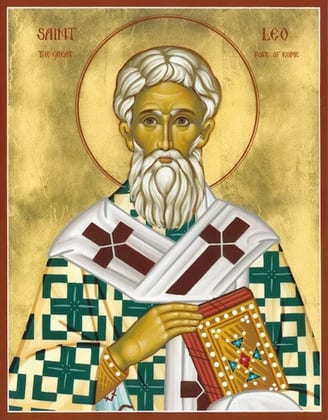
Pope of Rome whose dogmatic letter to Flavian of Constantinople, the Tome, was received by the Fourth Ecumenical Council at Chalcedon in 451 as the standard of the faith, the bishops crying out that Peter had spoken through Leo. He defended the city of Rome from Attila the Hun and is one of only two Popes the Church has named the Great.
- Born
- c. 400 (Tuscany)
- Reposed
- November 10, 461 (Rome)
- See
- Rome
- Feast
- February 18
Leo was born around the year 400, of a Tuscan family, and rose through the Roman clergy as a deacon of weight and learning under Popes Celestine and Sixtus III. While he was away in Gaul on an imperial commission, the clergy and people of Rome elected him bishop of the city, and he was consecrated in September of 440.
His pontificate fell in the years when the Church was tearing itself apart over the person of Christ. The archimandrite Eutyches of Constantinople taught that after the union the Lord had but one nature, the human swallowed up by the divine. When Eutyches was condemned and then restored by the violent synod that met at Ephesus in 449, the synod the Church has ever after called the Robber Council, Flavian of Constantinople appealed to Rome.
Leo answered with his Letter to Flavian, the Tome, setting out in measured Latin the confession of one Christ in two natures, each nature keeping its own proper character and acting in communion with the other. Two years later, at the Council of Chalcedon in 451, the Tome was read to the assembled Fathers, and the acts record that they cried out, This is the faith of the Fathers, Peter has spoken thus through Leo. His letter became, with the council's own Definition, the dogmatic charter of the Fourth Ecumenical Council.
He was as much a shepherd of the city as a teacher of the Church. In 452, when Attila and the Huns marched on Rome, Leo went out to meet him and persuaded him to turn back. Three years later, when the Vandals under Gaiseric entered the city, Leo could not prevent the sack but won from them the lives of the people and the churches. His sermons, preached through the cycle of the Christian year, remain among the clearest voices of the early Latin Church.
He governed the Roman Church for twenty-one years and reposed on the tenth of November, 461. The Church keeps his memory on the eighteenth of February. He is one of only two bishops of Rome on whom both East and West have set the title of the Great.
In his own words
For each form does what is proper to it with the co-operation of the other; that is the Word performing what appertains to the Word, and the flesh carrying out what appertains to the flesh.
St. Leo the Great, The Tome of Leo, Chapter 4, NPNF II 12
Events during this saint's life
Explore the interactive timeline
Books in print
These works are licensed and copyrighted by their publishers and cannot be hosted on Purify. As an Amazon Associate, Purify earns from qualifying purchases.
- SermonsBy Leo the Great · Catholic University of America Press, 1996The festal preaching of the pope whose Tome steadied Chalcedon: clear, measured homilies on the Nativity, the Passion, and the Ascension that confess the two natures of the one Christ.Buy on Amazon

Holy St. Leo the Great, pray to God for us.