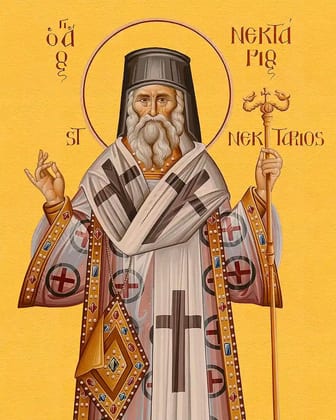
St. Nektarios of Aegina
Metropolitan of PentapolisFeast November 9
4 readers asked
A modern saint of the Greek tradition, a Metropolitan slandered out of his see who spent the rest of his life teaching poor seminarians in Athens, founded a convent on Aegina, was buried there in 1920, and within a generation was glorified as one of the most-loved wonderworkers of the Greek-speaking world.
- Born
- October 1, 1846 (Selybria, Eastern Thrace)
- Reposed
- November 9, 1920 (Athens)
- See
- Pentapolis in the Patriarchate of Alexandria
- Feast
- November 9
He was born Anastasios Kephalas in 1846 in Selybria, Eastern Thrace, to a poor Greek family. As a boy he travelled alone to Constantinople to work and study, sleeping in a shop and reading the Fathers by candle-light. At twenty-two he went to the island of Chios, was tonsured a monk with the name Lazarus, and a year later was given the name Nektarios at his monastic profession.
He was ordained deacon and sent at the expense of a benefactor to study at the Theological School of Athens, then to Alexandria, where the Patriarch Sophronios ordained him priest, made him archimandrite, and appointed him patriarchal secretary. In 1889, at the age of forty-three, he was consecrated Metropolitan of Pentapolis, the ancient titular see in Libya. He served the Patriarchate of Alexandria with a freshness and a closeness to the poor that earned him both immense affection from the people and the jealousy of senior clergy.
Calumnies were brought against him. The Patriarch, without trial, removed him from his see, and he was left a bishop without a diocese. He returned to Greece with no income and no welcome. For a year he walked the streets of Athens looking for any clerical work; finally he was given a small place preaching in country parishes, and then, when the slander followed him there too, was made the director of the Rizareios Ecclesiastical School in Athens, a teacher of poor seminarians, where he served fifteen years.
He lived in radical poverty and humility. The students saw him sweeping the school's floors before dawn, fixing the boys' shoes by hand, taking the blame for breakages he had not caused so that the cooks would not be punished. He wrote treatises on dogmatic theology, on the Church, on the Holy Trinity, on the path of repentance, on Christian morals, all in plain Greek, for the parish and the catechumen, not for the academy.
In his last years he founded a convent of nuns on the small Saronic island of Aegina, the Holy Trinity Monastery, restoring an old ruined community. He retired there in 1908, served the small church, heard the sisters' confessions, planted the gardens, and bore the long illness that finally killed him, cancer of the prostate, in great pain, in the Aretaieio public hospital in Athens. He fell asleep in the Lord on the night of November 8 / 9, 1920.
Within a year of his repose the wonders began. The patient in the next bed was healed when a sweater of Nektarios's was laid on him. His relics, when they were translated, gave off myrrh. The Greek Orthodox Patriarchate of Constantinople formally glorified him as a saint on April 20, 1961. The Holy Trinity Monastery on Aegina has since become one of the most visited pilgrimage sites in the Greek Orthodox world, and St. Nektarios is one of the most-loved modern wonderworkers in every Greek and Greek-tradition jurisdiction.
Books in print
These works are licensed and copyrighted by their publishers and cannot be hosted on Purify. As an Amazon Associate, Purify earns from qualifying purchases.
- Saint Nektarios: The Saint of Our CenturyAbout Sotos Chondropoulos · Kainourgia Ge Publications, 2000A widely-read narrative biography of St. Nektarios, schoolteacher, archbishop unjustly deposed, founder of the Aegina convent, and wonderworker, drawing on contemporary accounts of his patient suffering and posthumous miracles.Buy on Amazon

Holy St. Nektarios of Aegina, pray to God for us.