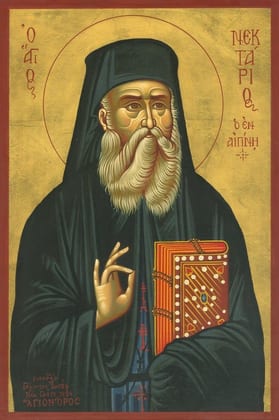
The bishop of Hierapolis whom Irenaeus calls 'a hearer of John, and a companion of Polycarp,' the writer of five lost books on the oracles of the Lord, and the earliest extra-biblical witness to the writing of the Gospels of Matthew and Mark.
- Born
- c. 70
- Reposed
- c. 155 (Hierapolis in Phrygia)
- See
- Hierapolis in Phrygia
- Feast
- February 22
Papias was bishop of Hierapolis in Phrygia, the same town in which the Apostle Philip had been crucified two generations earlier and where his prophesying daughters were remembered into the second century. He was a disciple of the Apostle John in John's old age, and a friend of Polycarp of Smyrna, who like himself had heard the Theologian.
Somewhere between 110 and 130 he composed a five-volume work in Greek under the title Expositions of the Oracles of the Lord. The five books are lost. Eusebius of Caesarea, two centuries later, preserved fragments that are now the chief witness to what they had contained. Irenaeus, Polycarp's disciple, quotes him also.
He had set himself, he wrote in his preface, to gather not only what was in the books but what the elders had reported of what Andrew or Peter or Philip or Thomas or James or John or Matthew or any of the rest of the Lord's disciples had said. He preferred, he confessed, a living voice to a written page, because the truth could be felt only in the company of one who had handled it.
Through Papias the Church possesses the earliest external accounts of the writing of the Gospels of Matthew and Mark, and a vivid fragment, attributed through John to the Lord, on the abundance of the world to come. The Orthodox tradition keeps his memory on the twenty-second of February, the day before that of his fellow disciple Polycarp.
Books in print
These works are licensed and copyrighted by their publishers and cannot be hosted on Purify. As an Amazon Associate, Purify earns from qualifying purchases.
- The Lives of the Saints for Orthodox ChristiansEdited by Dean Marais · Orthodox Christian Publications, 2024A single-volume synaxarion of six hundred saints, including the early bishop who treasured the 'living voice' of those who had heard the Apostles.Buy on Amazon
Holy St. Papias of Hierapolis, pray to God for us.