Purify
TodayBiblePrayersSaints
Discover
CalendarCommunityShop
SupportAccount

The Bible

  • Old Testament
  • New Testament
  • Search

The Saints

  • The Saints
  • The Fathers
  • Writings

The Library

  • Reading
  • Discover
  • Councils
  • Topics
  • Heresies
  • Shop

The Calendar

  • Today
  • This month
  • Pascha
  • The fasts

The Prayer

  • Open today's prayer
  • Morning Rule
  • Evening Rule
  • The Jesus Prayer
  • Learn to Pray

About this work

  • About
  • Purify Plus
  • Privacy
  • Terms
  • FAQ
  • Support the work
  • What's new
  • Account

Find us

Discord@purifymylife@purify.app@purifymylife
Language
Purify

Glory to God for all things.

© 2026 · 1.7.2 · Public-domain texts unless otherwise noted.

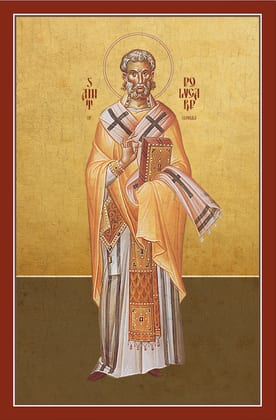
St. Polycarp of Smyrna

Icon of St. Polycarp of Smyrna

St. Polycarp of Smyrna

Bishop of Smyrna·Feast February 23

Ask for more writings

10 readers asked

The bishop of Smyrna who as a young man sat at the feet of the Apostle John, who pastored his church for upwards of sixty years, and who at the age of eighty-six was burned and finally stabbed for the Faith in the stadium of his city.

Born
c. 69
Reposed
c. 155 (Smyrna)
See
Smyrna in Asia Minor
Feast
February 23

Polycarp was born around the year sixty-nine, less than a generation after the Resurrection, and as a young man was a disciple of the Apostle John during John's last years at Ephesus. From John he received the Faith and from John, the tradition holds, his consecration as bishop of Smyrna in Asia Minor. He governed that see for upwards of sixty years.

He stands at the visible bridge between the apostolic generation and the second-century Fathers. He gave hospitality to Ignatius of Antioch as the chained bishop passed through Smyrna on the way to his martyrdom at Rome, received four of his letters, and gathered the others for forwarding. He afterwards wrote his own short letter to the Philippians, the only surviving writing from his hand. His own disciple, Irenaeus of Lyons, would as an old man recall the way Polycarp had described those who had seen the Lord, and would credit him with the orthodox reading of the Gospel of John against the Gnostics.

In his very old age he travelled to Rome to discuss the date of Pascha with Pope Anicetus. They could not bring their traditions into agreement, but they parted in peace, and Anicetus gave Polycarp the place of honor at the Eucharist as to one whose hands had been blessed by the hands of an apostle.

Around the year one hundred and fifty-five a pagan festival in Smyrna sought victims, and Polycarp was named. He was taken at a country house outside the city, set on an ass, and brought into the stadium before the proconsul, who pressed him to swear by the genius of the emperor and revile Christ. Polycarp answered that for eighty-six years he had served his Lord and that his Lord had done him no wrong; he could not blaspheme his King who saved him.

Holy St. Polycarp of Smyrna, pray to God for us.

He was condemned to be burned. As the fire was kindled around him he gave thanks aloud that he had been counted worthy to share in the cup of Christ. When the fire did not consume him, an executioner stabbed him with a dagger, and his blood put out the flames. The church of Smyrna gathered his bones as more precious than jewels and kept the annual day of his death as his 'birthday', the first surviving use of that expression for a martyr's anniversary, which the Church has not ceased to use since.

In his own words

  • Eighty and six years have I served Him, and He never did me any injury: how then can I blaspheme my King and my Saviour?
    The Martyrdom of Polycarp, Chapter 9, ANF 1
  • I give Thee thanks that Thou hast counted me, worthy of this day and this hour, that I should have a part in the number of Thy martyrs, in the cup of thy Christ, to the resurrection of eternal life, both of soul and body.
    The Martyrdom of Polycarp, Chapter 14, ANF 1

His disciples and successors

  • St. Irenaeus of LyonsDisciple at SmyrnaAs a boy Irenaeus heard Polycarp preach at Smyrna, and as an old man he could still describe the saint's appearance and manner. He carried the apostolic teaching west to Gaul, where as bishop of Lyons he wrote Against Heresies, defending the rule of faith handed down from the apostles through Polycarp.

Events during this saint's life

  • c. 155–156The Martyrdom of St Polycarp of Smyrna
  • c. 180St Irenaeus Writes Against Heresies
Explore the interactive timeline

3 works

  • Epistle to the Philippians
    Epistle to the PhilippiansThe bridge between St. John and St. Irenaeus · c. 110The only surviving writing from Polycarp's hand: a short letter to the Philippians on righteousness, the Eucharist, and the apostolic teaching, written within months of Ignatius's martyrdom. The fourteenth chapter is the historical anchor for the entire Ignatian corpus.
  • The Martyrdom of Polycarp
    The Martyrdom of PolycarpThe Encyclical Epistle of the Church at Smyrna · c. 155 (events) / c. 156 (encyclical)The earliest surviving Christian martyrology, written by the church of Smyrna to the church of Philomelium within a year of Polycarp's death. The eyewitness account of his arrest, his "eighty and six years I have served Him" before the proconsul, his prayer at the pyre, and the burning that became the model for every Christian martyrdom thereafter. The first known use of "birthday" for a martyr's day of death.
  • Eighty and Six Years
    Eighty and Six YearsFrom the Letter to the Philippians and the Martyrdom of Polycarp · c. 110-155His discipleship under John, his counsels to the Philippians on prayer, mercy, and watchfulness, and the eyewitness account of his martyrdom in the stadium of Smyrna.

Books in print

These works are licensed and copyrighted by their publishers and cannot be hosted on Purify. As an Amazon Associate, Purify earns from qualifying purchases.

  • The Apostolic Fathers
    The Apostolic FathersEdited by Michael W. Holmes · Baker Academic, 2007The standard scholarly diglot of the earliest sub-apostolic writings, containing Polycarp's Letter to the Philippians and the Martyrdom of Polycarp, the bishop of Smyrna who learned from the Apostle John and gave the Church its archetypal martyr's confession.Buy on Amazon

At a glance

Born
c. 69
Reposed
c. 155 (Smyrna)
See
Smyrna in Asia Minor
Feast
February 23