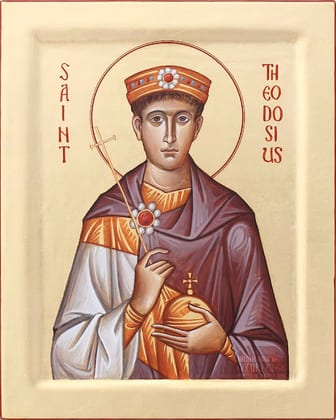
St. Theodosius the Great
Emperor of the RomansFeast January 17
Be the first to ask
The first emperor since Constantine to confess the Nicene Faith without reservation, who took the throne in 379 in the wake of the disaster at Adrianople, made the Nicene Faith the public confession of the empire (380), convened the Second Ecumenical Council at Constantinople (381), and submitted to public penance under St. Ambrose of Milan after the massacre at Thessaloniki (390).
- Born
- January 11, 347 (Cauca, Hispania)
- Reposed
- January 17, 395 (Milan)
- See
- Roman Emperor
- Feast
- January 17
Theodosius was born on January 11, 347, in Cauca in northern Spain, the son of the Roman general Theodosius the Elder. He was raised a Nicene Christian in a Spanish provincial home. He served as a young general under Valentinian I and was set aside under the Arian Emperor Valens.
When Valens was killed by the Goths at the battle of Adrianople in August of 378, the empire passed to the western Augustus Gratian, who recalled Theodosius from retirement and made him emperor of the East. Within a year of his elevation, Theodosius issued the Edict of Thessalonica (380) declaring the Faith of Nicaea, as held by the Bishop of Rome and the Patriarch of Alexandria, to be the public confession of the Roman world. The Arianizing settlements of the previous fifty years were quietly ended.
In 381 he summoned the Second Ecumenical Council at Constantinople, to ratify Nicaea, to confess the divinity of the Holy Spirit against the Pneumatomachi, and to set the order of the new Eastern patriarchates. He was present at the council in person, supported St. Gregory the Theologian when he was attacked, and, when Gregory withdrew to spare the council division, presided in person at the baptism, ordination, and consecration of Nectarius to the throne of Constantinople in a single day.
In April of 390 there was a riot at Thessaloniki in which an imperial general was killed by the crowd. In retaliation Theodosius ordered a public reprisal in the city's circus, and the slaughter was extensive (the traditional figure is seven thousand). St. Ambrose of Milan refused him Communion until he had done public penance. Theodosius came out of his palace in the dress of a penitent, stood at the door of the cathedral of Milan with the catechumens, and was not received again to the Holy Mysteries until he had wept his way through the canonical period of penance. It is the most famous instance in the patristic age of an emperor submitted to the discipline of the Church, and the principle has stood ever since: there is no rank in the Body of Christ above the canons of the Faith.

Books in print
These works are licensed and copyrighted by their publishers and cannot be hosted on Purify. As an Amazon Associate, Purify earns from qualifying purchases.
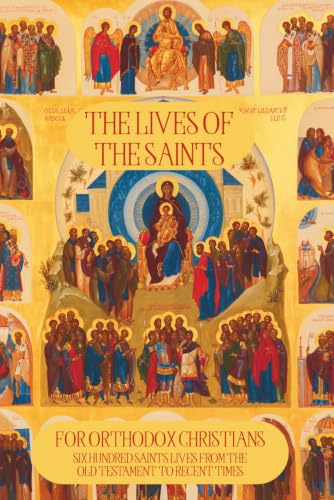
- The Lives of the Saints for Orthodox ChristiansEdited by Dean Marais · Orthodox Christian Publications, 2024A single-volume synaxarion of six hundred saints, including the emperor who made the Nicene faith the faith of the empire and bowed to St. Ambrose in penance.Buy on Amazon
Holy St. Theodosius the Great, pray to God for us.