Purify
TodayBiblePrayersSaints
Discover
CalendarCommunityShop
SupportAccount

The Bible

  • Old Testament
  • New Testament
  • Search

The Saints

  • The Saints
  • The Fathers
  • Writings

The Library

  • Reading
  • Discover
  • Councils
  • Topics
  • Heresies
  • Shop

The Calendar

  • Today
  • This month
  • Pascha
  • The fasts

The Prayer

  • Open today's prayer
  • Morning Rule
  • Evening Rule
  • The Jesus Prayer
  • Learn to Pray

About this work

  • About
  • Purify Plus
  • Privacy
  • Terms
  • FAQ
  • Support the work
  • What's new
  • Account

Find us

Discord@purifymylife@purify.app@purifymylife
Language
Purify

Glory to God for all things.

© 2026 · 1.7.2 · Public-domain texts unless otherwise noted.

Holy Apostle and Evangelist John

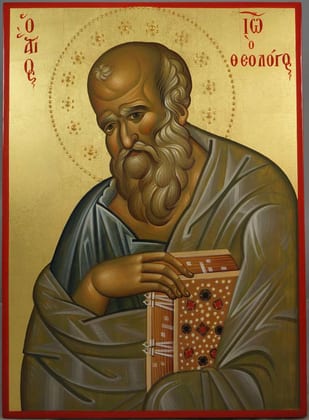
Icon of Holy Apostle and Evangelist John

Holy Apostle and Evangelist John

The Theologian·Feast May 8

Ask for more writings

12 readers asked

The fisherman of Galilee whom the Lord loved, who reclined on his breast at the Mystical Supper and stood beneath his Cross, and who afterwards wrote the Fourth Gospel, the three catholic epistles, and the Apocalypse, the only apostle to die in peace, having lived to a very great age at Ephesus.

Born
1st century (Bethsaida of Galilee)
Reposed
c. AD 100 (Ephesus)
See
Ephesus
Feast
May 8 · September 26

John was the son of Zebedee, a fisherman of Bethsaida, and of Salome, who according to tradition was a daughter of Joseph the Betrothed and therefore a kinswoman of the Lord. He and his elder brother James were partners with Simon Peter in the fishing trade on the Sea of Galilee, and were called by the Lord from their nets on the same day Peter was called.

From the first he was reckoned among the Lord's closest disciples. With Peter and James he alone was admitted to the raising of Jairus's daughter, to the Transfiguration on Tabor, and to the agony in Gethsemane. He calls himself in his own Gospel only 'the disciple whom Jesus loved,' and that disciple reclined on the Lord's breast at the Mystical Supper.

He was the only one of the Twelve who did not flee on the night the Lord was taken. He followed to the courtyard of the high priest, and stood at the foot of the Cross, and there received from the dying Lord the charge of his Mother: 'Behold thy mother.' He took her into his own house, and cared for her until her Dormition.

He was among the first at the empty tomb on the morning of the Resurrection, saw the linen clothes lying, and believed. After Pentecost he laboured with Peter at Jerusalem and was reckoned one of the pillars of the Church there.

Holy Holy Apostle and Evangelist John, pray to God for us.

Tradition relates that after the Dormition of the Theotokos he settled at Ephesus, the great Christian metropolis of Asia, and was the spiritual father of all the churches of Asia Minor. Exiled by the emperor Domitian to the island of Patmos, he received there the visions that became the Book of Revelation. Returning to Ephesus under Nerva, he wrote in his very old age the Fourth Gospel, that the Church might know in his words who the Word had been from before the world. He wrote also the three catholic epistles, the last of them perhaps the briefest writing in the New Testament.

He lived to a very great age, the tradition says past a hundred, and was the only one of the Twelve to die in peace. The Fathers add that he laid himself down in a grave he had himself prepared at Ephesus, and when his disciples opened it the next day his body was no longer there. The Church keeps the memory of his Dormition on the twenty-sixth of September and a feast of him with the rest of the Twelve on the thirtieth of June; on the eighth of May, the tradition relates, a fragrant dust rose from his grave and brought healing to all who took it, and that miracle is kept as its own feast.

In his own words

  • In the beginning was the Word, and the Word was with God, and the Word was God.
    John 1:1, King James Version
  • And the Word was made flesh, and dwelt among us.
    John 1:14, King James Version
  • That which was from the beginning, which we have heard, which we have seen with our eyes, which we have looked upon, and our hands have handled, of the Word of life.
    1 John 1:1, King James Version
  • Beloved, let us love one another: for love is of God.
    1 John 4:7, King James Version
  • He that loveth not knoweth not God; for God is love.
    1 John 4:8, King James Version

His disciples and successors

  • St. Ignatius of AntiochDisciple at AntiochBishop of Antioch and one of the small handful of figures who form the visible bridge from the apostles to the Fathers. Formed by John in his years at Ephesus, he carried the Johannine teaching on the Word, the Eucharist, and the unity of the Church into his seven letters, written in chains on the road to martyrdom at Rome around 108.
  • St. Polycarp of SmyrnaDisciple at EphesusAs a young man Polycarp sat at John's feet at Ephesus and was made by him bishop of Smyrna. He shepherded that church for upwards of sixty years and was burned and stabbed in its stadium around 155, at the age of eighty-six. His own disciple Irenaeus carried the chain one further link west into Gaul.
  • St. Papias of HierapolisHearer at EphesusBishop of Hierapolis in Phrygia and a friend of Polycarp, Papias was 'a hearer of John' and gathered from the elders who had known the apostles the earliest external accounts of the writing of the Gospels of Matthew and Mark.
  • St. Prochorus, Deacon and BishopScribe on PatmosOne of the Seven Deacons of Acts 6, who according to tradition accompanied John into exile on Patmos and wrote at the apostle's dictation. The iconography of John the Theologian on Patmos almost always shows Prochorus at his feet, pen in hand.

Events during this saint's life

  • c. 33Pentecost: the Descent of the Holy Spirit
  • c. 49–50The Council of Jerusalem
  • c. 155–156The Martyrdom of St Polycarp of Smyrna
Explore the interactive timeline

2 works

  • The Life of St. John the Theologian
    The Life of St. John the TheologianFrom the New Testament, Polycrates, Irenaeus, Tertullian, Clement, Eusebius, and JeromeA careful five-section vita drawn from documented public-domain sources in order of antiquity: the Gospel, Epistles, Apocalypse, and Acts as autobiographical witness (KJV); Polycrates of Ephesus (Eusebius H.E. III.31, V.24); Tertullian, De Praescriptione Haereticorum 36 (ANF 3); Irenaeus, Against Heresies II.22.5, III.1.1, III.3.4, V.30.3 (ANF 1); Clement of Alexandria, Quis Dives Salvetur 42 via Eusebius (H.E. III.23); Papias via Eusebius (H.E. III.39); Eusebius, H.E. III.18, III.23, III.31 (McGiffert NPNF 1890); and Jerome on Galatians 6:10 (NPNF II.3). The apocryphal Acts of John is named as a second-century devotional composition. The question of John the Apostle vs the Elder is set out and the older five-fold attribution is followed without pretending the Papias-and-Dionysius question has not been asked.
  • Selected Passages from the Gospel and First Epistle
    Selected Passages from the Gospel and First EpistleFrom the Theologian's Gospel and his catholic epistles · c. 90-100Four passages from the Fourth Gospel and the First Epistle: the Prologue, the new commandment of love, the High-Priestly Prayer, and the great chapter that confesses God is love.

Books in print

These works are licensed and copyrighted by their publishers and cannot be hosted on Purify. As an Amazon Associate, Purify earns from qualifying purchases.

  • Commentary on the Apocalypse
    Commentary on the ApocalypseAbout Andrew of Caesarea · The Catholic University of America Press, 2011The earliest complete Greek patristic commentary on the Book of Revelation, Andrew of Caesarea reading St. John's Apocalypse within the consensus of the Eastern Fathers. Eugenia Scarvelis Constantinou's translation, the first into any modern language.Buy on Amazon

At a glance

Born
1st century (Bethsaida of Galilee)
Reposed
c. AD 100 (Ephesus)
See
Ephesus
Feast
May 8 · September 26